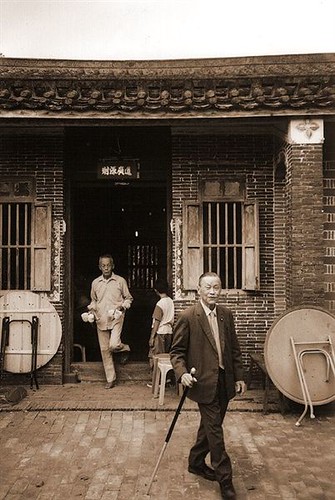
Uncle Y Y Lee outside the house he was born in
A couple of things precipitated this blog post. First, I found a link from this Hainan Island related site.
Then I remembered that my uncle (father’s brother) didn’t attend my wedding because, as my cousin informed me a day before that, that he ‘couldn’t make it, because his leg cannot lah’, and how I thought it would have been nice for him and my dad to meet up, given that both of them are coming along in age, though at this time, I don’t want to say either of them is ‘ailing’.
I was a bit disappointed because I had even gotten Naomi to practice saying ‘Uncle, drink tea’ in Hainanese, after asking my father how to say ‘Uncle, drink tea’ in Hainanese.
It’s been a while since Part Three, and even longer since I was actually on the trip to the island of my forefathers.
The tour bus took us to Kachek town, and dropped us off at a 3-star hotel (so my cousin told me), but by this time, whatever stars that rated hotels on Hainan meant little as we checked ourselves into our rooms with the rock hard coconut husk beds.
After resting a bit in our rooms, my cousin made another phone call to the ancestral village to inform whatever relatives we had there that we had arrived. We were then told that ‘a few of them would be coming down to have coffee with us’.
I had never spoken to any of these relatives, much less known what they looked like, though I’ve been told that all Hainanese men look alike, and that every waiter at Shashlik looked like Dad, and Mum had previously told me that all Hainanese women looked like my grandmother. At 80.
But none of us expected a welcoming committee from the village, on a rickety hired bus, driving into the hotel’s car park and disembarking into the lobby, to ‘have coffee with us’. I think there were at least a dozen of them. At least they didn’t bring any coconut-related souvenirs, because by that time I had sworn off coconuts for life. It’s a bit hard to explain how pervasive the coconut problem is, but you’d get an indication reading the tourist information for the City of Wenchang, which begins like this:
Distinguished by the quality and quantity of its assorted coconut products, Wenchang City is a vital gateway to a lively area that contains some of Hainan Province’s most charming sightseeing and holiday destinations…
Coffee at the hotel’s lobby cafe, which also served all manner of coconut drinks, took a good two hours, with long conversations, mostly with the Hainanophone among us jabbering away, and with me nodding and smiling. My cousin later told me that my relatives were telling us about the sad state of my great grandfather’s grave, which, due to lack of maintenance, due to a lack of funds coming from the Lee family overseas, had been overrun by chickens from the free range chicken farm nearby.
The next morning, the rickety bus came to the hotel to fetch us to the village, this time, only six relatives served as entourage, and about an hour into the journey, we arrived at a dusty, non-descript township, where, upon the gutteral utterances of the driver (who was a cousin as well, I discovered) we disembarked and were led into a shophouse, where we were made to buy incense, hell-money and enough firecrackers to burn down a small town.
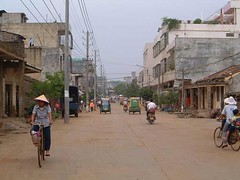
The township looked something like this: Dusty and unremarkable
Then bus driver-cousin said something, and my travelling-companion-cousin handed more cash over to him, and off we went to another shophouse, where more things were bought. All this while, of course, we had to keep my uncle from buying more coconut-related souvenirs.
Another half hour on the bus and on a dirt road where we passed several tiny villages with really old-looking buildings, we disembarked outside a little drinks kiosk-like building that had benches and a shelf that looked like it would have housed a television set. Bus driver-cousin and entourage-cousins beckoned for us to follow them behind the building, on a tiny footpath lined by trees. A five-minute trek later, we were in what looked like a little nook in the woods, with a cluster of buildings that made the place look like the set of ‘Crouching Tiger, Hidden Dragon’. It was that old.
We walked past a well with an electric motor pump, which my cousin said was the ‘running water’ that my Dad and uncle had donated money to the village for, and then we were guided through a courtyard and into a small house. On the wall were photographs of people who looked really familiar – and then I realised they were of my uncle and of Dad, taken some time in the 60s. Alongside those photos were those presumably of other uncles and cousins, though, like I’ve been told, you can’t really tell because all Hainanese men look the same.
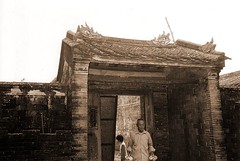
A very distant cousin brings coffee mugs out of the house
A few chairs lined the walls, and we were asked to sit and wait as scores of people started streaming into the house, and according to my cousin, all of whom claimed to be a cousin or other. This was supposed to make us give them ang pow money or something. Some came, said a few words, took their share, and left, while others would come in, jabber away for a longer time, leave, and then come back again to say some more.
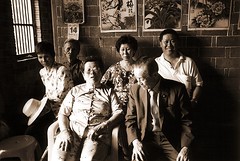
Uncles, aunts and cousins cram for a photo
Then a line of men came into the house, and I was told they were the village school’s teaching staff. Remembering that my Dad told me he donated money to build the village school, I asked to be taken to the school for a look. It was a pretty rundown two-storeyed building, and empty. Then one of the teachers showed me a few Peruvian nuevos soles from his wallet, and asked in Mandarin if they were American dollars. ‘South American’, I said, in Mandarin. He then insisted they were American dollars, because, he said, someone had exchanged them for a substantial amount of Renminbi with him.
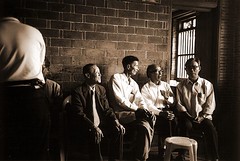
Uncle Y.Y. with the visiting schoolteachers
Then came time to visit great grandfather’s chicken overrun grave. Bus driver-cousin led the way via a series of footpaths, holding the long coil of firecrackers we had let him buy earlier. There was a small headstone which he dusted off, and we could make out our surname on it, and not much else. Not that it would’ve mattered, since neither of my travelling-companion cousins could read Chinese.
The thing about Great Granddad’s grave was that it was situated in sort of an open ground, sort of in between villages. It wasn’t in a cemetery proper, which probably explained the chickens running amok and flattening, over the years, the mound that distinguished a grave as a Chinese one.
The chickens were there when we got to the grave, but no matter, Great-Granddad was treated to the longest firecracker barrage I’d ever heard, and we returned to the house as soon as the smoke cleared, which was after we had stamped out the little brushfires that the firecrackers and burning hell notes started, but I think we were slightly pleased that the rogue chickens were probably scared shitless and deaf by now.
But one of my cousins was quite visibly disturbed, and she paused to ask why Great-Granddad was buried so near the house, to which I offered, ‘because last time no ambulance, people die already got no car to take them to the cemetery’. She seemed pretty satisfied with that explanation, which was good, because I was being eaten alive by mosquitoes at that point, and wanted to get out of the bush as soon as possible.
Back at the house, a feast was being prepared for the visiting Lees. This meant half the duck population in the village squawked their last as they were turned into the county’s specialty – boiled/steamed duck. The courtyard outside the house was set up with tables and stools, as we were taken indoors and shown the room which Uncle Y.Y. and my Dad were born in.
I was told how both Uncle and Dad had left Hainan at a very early age to look for Granddad in Malaya, leaving Grandma behind until she managed to find her way to Malaya via Vietnam, Cambodia and Thailand.
There were stories of other cousins and uncles who left the island from the 1930s onwards, in a two-generation long diaspora that waned only recently, and probably ended with the reverse migration of several old Hainanese back to the village from Malaysia and Indonesia.
But food was served, steaming duck with the county’s other specialty – a yellowish chili sauce that was spicier than it looked. The feast was surprisingly good, although I remained a little unnerved by the number of villagers who stared and kept commenting how much I looked like Granddad and Dad.
After the meal, my cousin requested that we be brought back to Kachek town as it was getting late and that we didn’t want to keep them from doing their thing, seeing as it was a weekday and all. Of course, the villagers didn’t do much besides tending to the ducks and vegetables, whether it was a weekday or not, because most of the able-bodied members of the Lee clan had long since gone to the cities for work, leaving only the old and very young crouching and hiding about the village buildings.
Truth was, we were looking for clean toilets, and the amenities in the village would have been less than able to withstand the work of my weak stomach.
After we were dropped off back at the hotel, and goodbyes said (including a false promise of a return to the village the next day), we flagged a taxi and asked the driver to take us downtown, the Singapore-Malaysian-Hainanese word for which was different from the Hainanese-Hainanese word.
At the chicken slaughterhouse a few minutes outside downtown Kachek, the taxi-driver laughed his Hainanese head off when we explained that our word for ‘downtown’ sounded exactly like his word for ‘chicken farm’, and that we really didn’t want to have dinner there.
Having made his day, the taxi-driver very kindly took us downtown, to a street with many outdoor food stalls, where we had a dinner of fried noodles before my female cousin said she was going to look for a dessert that our late Grandma used to tell her about. Something called ‘Guay Dai Din’ in Hainanese, which translates to ”Chicken Shit’ Something’ in English.
She found it, this Chicken Shit Something, and ordered a large basin of sweet syrup filled with black starch pellets, to share with all of us. It wasn’t half bad, this dessert, and I think it would’ve made it to Southeast Asian Hainanese kitchens and restaurants if it wasn’t saddled with such a marketing problem.
The next day, the tour van came back and picked us up for the long drive back south to Sanya, where we were treated to more coconut-related tourist spots before finally boarding the charter back to Kuala Lumpur, with a hundred odd Hainanese pilgrims carrying a load of coconut by-products and many, many stories of the home country.
Technorati Tags: china, hainan


Leave a Reply